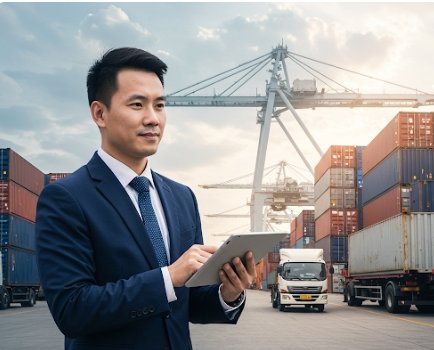
Cross-border dedicated line logistics is a one-stop, fixed-route, and standardized logistics product created by cross-border logistics service providers to adapt to cross-border e-commerce B2C/B2B scenarios. It integrates three core links: initial transportation, customs clearance in the destination country, and local last-mile delivery. Simply put, it’s a “dedicated logistics channel from China to a specific country/region,” such as the Matson express line, European air freight dedicated line, and Southeast Asian land transport dedicated line.
It is not an independent mode of transportation, but rather a deep integration of basic transportation methods such as sea, air, and land transport with customs clearance in the destination country and local delivery. The entire process is handled by a single logistics provider. It is a form of logistics that falls between traditional international logistics (full container/less than container load sea freight, air freight) and international express delivery, focusing on cost-effectiveness, stable timeliness, and one-stop service. It is also the mainstream choice for cross-border e-commerce sellers.
Ordinary logistics refers to traditional international sea, air, and land freight services for loose cargo/less than container load shipments, as well as basic international express services. These types of logistics are often “segmented services,” requiring the shipper to independently connect with different service providers for different stages. They have a low degree of standardization and are mostly suitable for traditional B2B foreign trade, with low compatibility with the small-batch, high-frequency, and door-to-door needs of cross-border e-commerce.
Next, Weefreight will provide you with a detailed analysis, hoping it will be helpful to you. I. Core Types of Cross-Border Dedicated Logistics Lines (Classified by First-Mile Transportation Method)
The core difference in cross-border dedicated lines lies in the first-mile trunk transportation method. Different types of dedicated lines have their own characteristics in terms of timeliness, cost, and suitable cargo types. They all cover the entire chain from “domestic door-to-door pickup → first-mile cross-border transportation → customs clearance in the destination country → local last-mile delivery → final delivery and signing,” with the following four main types covering over 90% of cross-border e-commerce scenarios:
Sea Freight Dedicated Lines: The first-mile transportation uses fast or regular sea freight. This is currently the most mainstream type of dedicated line for cross-border e-commerce, such as the US West Coast Matson fast ship dedicated line and the European sea freight dedicated line. The timeliness is 3-7 days faster than traditional sea freight LCL (less than container load), and the cost is only 1/3 of air freight dedicated lines. It is suitable for cross-border e-commerce overseas warehouse stocking and large-volume direct shipments from stores, and is suitable for general goods such as daily necessities, home appliances, clothing, and shoes.
Air Freight Dedicated Lines: The first-mile transportation uses international air freight direct flights. The timeliness is faster than sea freight dedicated lines, but slightly slower than international express delivery. The cost is 1/2 to 1/3 of international express delivery, such as European and American air freight dedicated lines and Southeast Asian air freight dedicated lines. It is suitable for urgent orders and high-value small items shipped directly from cross-border e-commerce stores, and is suitable for 3C accessories, cosmetics, and maternal and infant products.
Land Freight Dedicated Lines: The first-mile transportation uses land transportation methods such as China-Europe freight trains and China-Vietnam road/railways. It is only suitable for areas with land borders/dedicated lines between China and Europe, Southeast Asia, etc. The timeliness is between sea and air freight, and the cost is stable, such as the China-Europe freight train dedicated line and the Southeast Asia land freight dedicated line. It is suitable for goods with moderate timeliness requirements and moderate cargo volume. Small Parcel Dedicated Lines: The first leg of the journey is mostly air or sea freight consolidation, while the last leg connects to the destination country’s local postal service or economical express delivery. These services focus on “lightweight, small items, low cost, and wide coverage,” such as Yanwen Small Parcel and YunTu Dedicated Lines. They are suitable for cross-border e-commerce small parcels weighing less than 2kg and are the preferred choice for direct shipping from small and medium-sized sellers’ stores, covering most countries/regions worldwide.
II. Core Advantages of Cross-border Dedicated Logistics Lines Compared to Ordinary Logistics
Cross-border dedicated logistics lines are “tailor-made” for the needs of cross-border e-commerce. Compared to traditional ordinary logistics (sea/air freight consolidation, international express), the core advantages are reflected in five dimensions: service model, timeliness, cost, customs clearance, and operational convenience. They perfectly solve the pain points of ordinary logistics in adapting to cross-border e-commerce:
- Service Model: One-stop all-inclusive service, no need to deal with multiple parties, making it worry-free even for beginners.
Ordinary logistics often involves segmented services. Traditional sea/air freight consolidation requires the shipper to independently contact domestic freight forwarders, destination country customs brokers, and local delivery companies. If any link has a problem, the shipper needs to communicate and coordinate independently. Although international express is a one-stop service, it is only suitable for small items; if the shipper is unfamiliar with the cross-border logistics process, it is easy to encounter gaps in the process and problems of responsibility shifting.
Cross-border dedicated logistics lines provide a full-service, one-stop solution. The shipper only needs to deal with a single logistics provider, from domestic door-to-door pickup and packaging, to the first leg of cross-border transportation, customs clearance in the destination country, and finally to local last-mile delivery and final signing. The logistics provider is solely responsible for all aspects of the process and assumes all risks. The shipper only needs to track the logistics trajectory in real time and does not need to handle any intermediate links. The operational threshold is extremely low, making it easy for even novice cross-border e-commerce sellers to get started. 2. Timeliness: Fixed routes and guaranteed cargo space, faster and more stable than traditional sea/air freight consolidation.
Traditional sea/air freight consolidation requires shippers’ goods to be combined with goods from different destinations and different shippers. This often leads to delays due to waiting for consolidation, and cargo space is not guaranteed. During peak seasons, it’s easy to encounter situations where “cargo space cannot be booked,” resulting in significant fluctuations in delivery times. While international express delivery is fast, it is affected by flight capacity, and delays can also occur during peak seasons.
Cross-border dedicated logistics lines have fixed routes and schedules. Logistics providers pre-book exclusive cargo space with shipping companies/airlines. The initial transportation does not require consolidation, and shipments depart/load according to fixed schedules. Furthermore, goods on cross-border dedicated lines enjoy priority customs clearance and container retrieval at the destination port. The last-mile delivery also utilizes dedicated channels of local logistics providers in the destination country. Compared to traditional sea/air freight consolidation, delivery times are 3-7 days faster, with an on-time rate of over 90%. Delivery times are also more stable during peak seasons, accurately matching the inventory and shipping time requirements of cross-border e-commerce.
- Cost: Higher cost-effectiveness, perfectly balancing timeliness and cost, adapting to the profit needs of cross-border e-commerce.
The costs of ordinary logistics are either “too high” or “have low suitability”: International express delivery is the fastest, but the cost is extremely high, with freight costs increasing significantly for goods over 2kg, which is difficult for cross-border e-commerce sellers to bear; traditional sea/air freight consolidation is low-cost, but only suitable for large quantities of goods. The unit cost for small quantities of goods is high, and multiple handling fees are added, resulting in no overall cost advantage. Cross-border dedicated logistics lines achieve an optimal balance between efficiency and cost. Their costs are significantly lower than international express delivery (approximately 1/2 to 1/5 of the cost of international express), and slightly higher than traditional sea/air freight consolidation in terms of unit cost. However, they eliminate many miscellaneous fees associated with ordinary logistics (such as destination country customs clearance agent fees and sorting fees), and there are no hidden costs, with transparent pricing. Furthermore, cross-border dedicated lines offer tiered pricing based on shipment volume; the larger the volume, the lower the unit cost, meeting the cost needs of cross-border e-commerce businesses for all shipment sizes, from small packages to large-scale inventory, maximizing sellers’ profit margins.
- Customs Clearance: Dedicated Channels, Batch Declaration, High Clearance Efficiency and Success Rate
Ordinary traditional sea/air freight consolidation uses a “single declaration, separate customs clearance for each consignee” model. If one consignee’s goods in a consolidated shipment have discrepancies in documents or product descriptions, all goods in the entire container will be affected and delayed. Moreover, ordinary consolidated shipments lack dedicated customs clearance channels, resulting in longer clearance times and a higher risk of delays due to other consignees’ issues. Small quantities of goods using ordinary postal customs clearance are prone to slow clearance and seizure.
Cross-border dedicated logistics lines utilize dedicated customs clearance channels and standardized batch declarations. The logistics provider has long-term cooperative customs brokers in the destination country and conducts standardized review of declaration documents for dedicated line shipments, proactively mitigating customs clearance risks. Simultaneously, dedicated line shipments use batch declaration, resulting in significantly higher clearance efficiency than ordinary consolidated shipments. Clearance time is shortened by 3-5 days compared to traditional logistics, and the clearance success rate is over 99%, with very few instances of goods being delayed or seized due to customs clearance issues, addressing the biggest customs clearance concerns of cross-border e-commerce sellers. 5. Adaptability: Precisely matches the small-batch, high-frequency, and door-to-door needs of cross-border e-commerce.
Traditional logistics is designed to accommodate the large-volume, low-frequency, and port-to-port needs of traditional B2B foreign trade. Traditional sea/air freight consolidation has high minimum cargo volume requirements and is mostly a “port-to-port” service, not including door-to-door delivery; while international express delivery is door-to-door, it only suits small packages and cannot meet the large-volume inventory needs of cross-border e-commerce. Overall, it has a very low match with the small-batch, high-frequency, door-to-door, and global coverage needs of cross-border e-commerce B2C.
Cross-border dedicated logistics is tailor-made for cross-border e-commerce B2C, with no minimum cargo volume requirements. It can handle anything from a single package to a full container, meeting sellers’ “high-frequency, small-batch” shipping needs; at the same time, it provides full “door-to-door” service, from pick-up at the domestic seller’s warehouse to direct delivery to overseas consumers/overseas warehouses, eliminating the need for sellers to deliver goods to ports/airports themselves; and the coverage of cross-border dedicated lines is extremely wide, covering not only mainstream markets such as Europe and the United States, and Southeast Asia, but also emerging markets such as Latin America, Africa, and the Middle East, perfectly matching the needs of cross-border e-commerce sellers to “sell globally.”
- Logistics Tracking: Fully visualized, real-time tracking updates, and traceable.
With ordinary traditional sea/air freight consolidation, the logistics trajectory can only be tracked to the port/airport. The tracking of customs clearance and delivery in the destination country cannot be updated in real time, and the cargo owner cannot know the specific status of the goods, making it impossible to trace problems in a timely manner; some ordinary small package logistics have delayed tracking updates, or even “tracking gaps.” Cross-border dedicated logistics lines have created a fully visualized logistics tracking system, integrating all tracking points of first-mile transportation, destination country customs clearance, and last-mile delivery into a single system. Both shippers and overseas consumers can view the specific location and status of their goods in real time. From domestic pickup to final delivery, every step is recorded and traceable, solving the problem of opaque tracking in traditional logistics and improving the logistics experience for both sellers and consumers.
III. Supplement: Key Differences Between Cross-border Dedicated Logistics and International Express (to avoid confusion)
Many newcomers confuse cross-border dedicated logistics with international express. Although both offer one-stop door-to-door services, their core application scenarios differ. The key differences are as follows:
Volume Suitability: Cross-border dedicated logistics has no volume restrictions; it can handle anything from a single package to a full container, suitable for all volume needs of cross-border e-commerce; international express is only suitable for small packages under 20kg, and the cost for larger items is extremely high, offering no advantage.
Cost and Timeliness: Cross-border dedicated logistics is slightly slower than international express (1-3 days slower), but the cost is only 1/2 to 1/5 of international express; international express is the fastest, but the cost is extremely high, suitable for urgent orders and samples.
Coverage and Experience: International express offers a better last-mile delivery experience, suitable for high-value goods and those requiring a high-quality experience; cross-border dedicated logistics has a wider coverage, especially in emerging markets such as Latin America and Africa, making it suitable for ordinary goods shipped directly from stores.
(Note: The above timeliness and costs are for reference only. Please refer to the actual situation at the time of shipment. Thank you!)
If you have any international logistics service needs, please click on the floating chat icon in the lower right corner or other contact methods on the lower right of the page to contact us immediately!